

Part 102 - Certificated Operations
Understanding how unmanned aircraft operators are certificated in New Zealand
Part 102 provides a framework for unmanned aircraft operations that cannot be conducted entirely within the general requirements of Part 101, as well as for operators who voluntarily seek certification.
Under Part 102, the Civil Aviation Authority (CAA) assesses an operator's proposed activities, the risks involved, and the systems and procedures established to manage those risks.
A certificated operator may be authorised to conduct specific activities under conditions that differ from the standard Part 101 requirements. The scope of those activities is defined by the operator's Operations Specifications, supported by their exposition and any applicable conditions.
Certification applies to the operator and their approved operating arrangements. It does not give every pilot or aircraft associated with that operator unrestricted operating privileges.
How Part 102 certification works
Part 102 is an operator certification framework. Rather than prescribing a single set of operating conditions for every activity, it allows the Civil Aviation Authority (CAA) to assess the activities an operator proposes to undertake and the arrangements established to manage the associated risks.
An applicant must demonstrate that the risks to aviation safety have been adequately assessed and that appropriate procedures have been developed to manage those risks.
Certification involves several interconnected elements:
The operator: The person or organisation responsible for the activities conducted under the certificate.
The exposition: The documented operating arrangements, responsibilities, procedures and risk management measures.
CAA assessment: The Authority's evaluation of the proposed activities and whether the operator can conduct them safely.
The operator certificate: The certification granted by the CAA.
Operations Specifications (Ops Specs): The document accompanying the certificate that identifies the approved operations, privileges and conditions.
These elements work together. An operator must conduct its activities within the scope of its certification and in accordance with the applicable conditions and procedures.
Relevant provisions: Rules 102.1, 102.9, 102.11, 102.13, 102.15 and 102.21.
Operating privileges
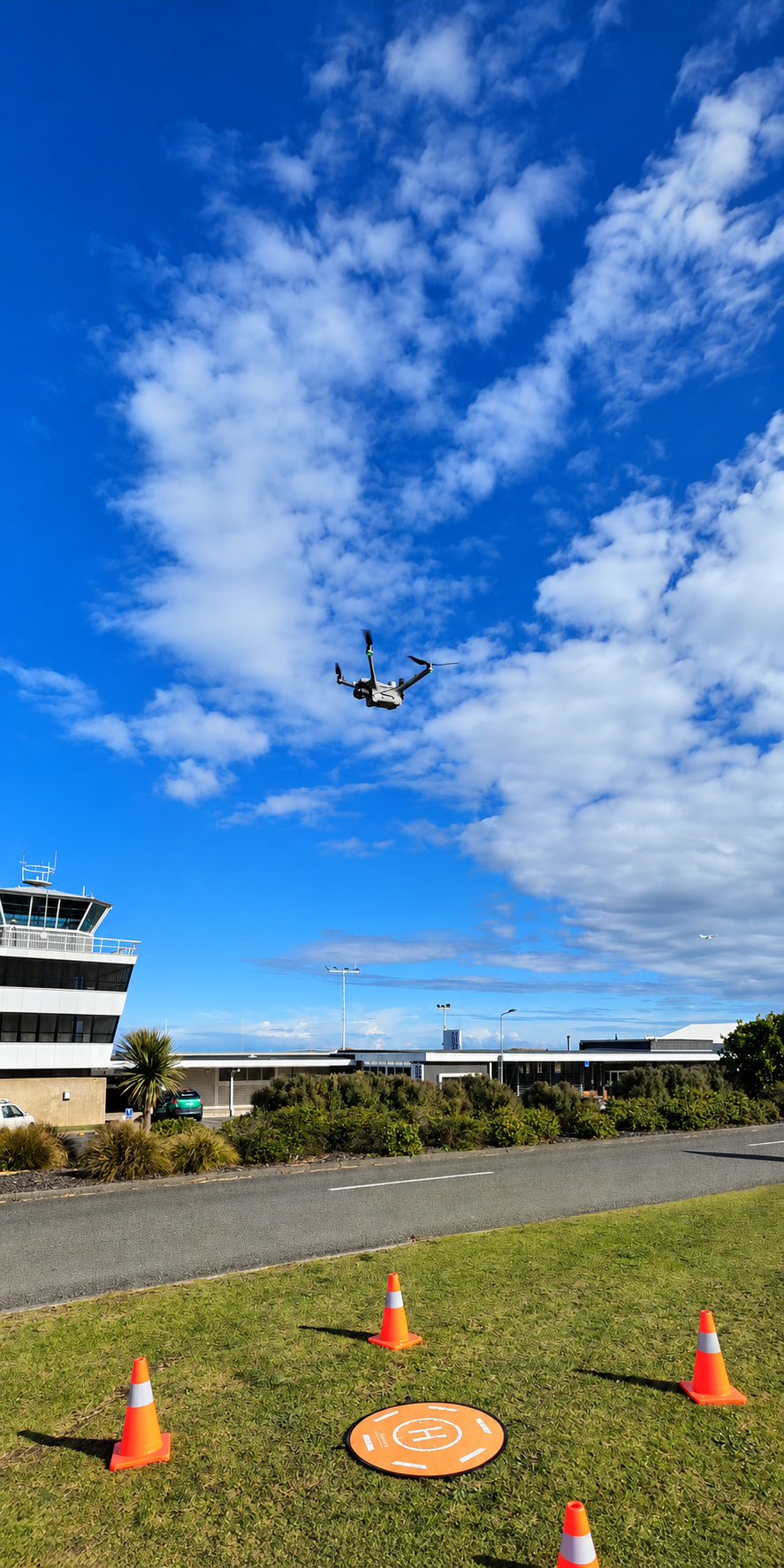
Part 102 enables operators to seek authorisation for activities that cannot be conducted within the ordinary Part 101 requirements.
The privileges granted depend on the operator's proposed activities, the risks involved and the arrangements accepted by the CAA.
Examples of operations for which Part 102 authorisation may be sought include:
Beyond visual line of sight (BVLOS): Operations where the aircraft is not continuously observed directly by the pilot or an appropriate visual observer.
Operations above the general Part 101 height limit: Where an applicable Part 101 pathway is not available or suitable.
Operations involving people or property: Approved arrangements that differ from the ordinary Part 101 consent requirements.
Night operations: Activities outside the night-operating provisions available under Part 101.
Larger unmanned aircraft: Operations involving aircraft exceeding the ordinary Part 101 mass limits.
Specialised operations: Activities requiring additional risk controls, such as certain infrastructure, agricultural or other complex operations.
These are examples of activities that may require Part 102 certification, not privileges automatically granted to every certificate holder.
An operator may be approved for some of these activities and not others. Specific limitations may also apply to aircraft, operating areas, personnel, procedures and environmental conditions.
Relevant provisions: Rules 102.3, 102.7, 102.15 and 102.17.
Operations Specifications
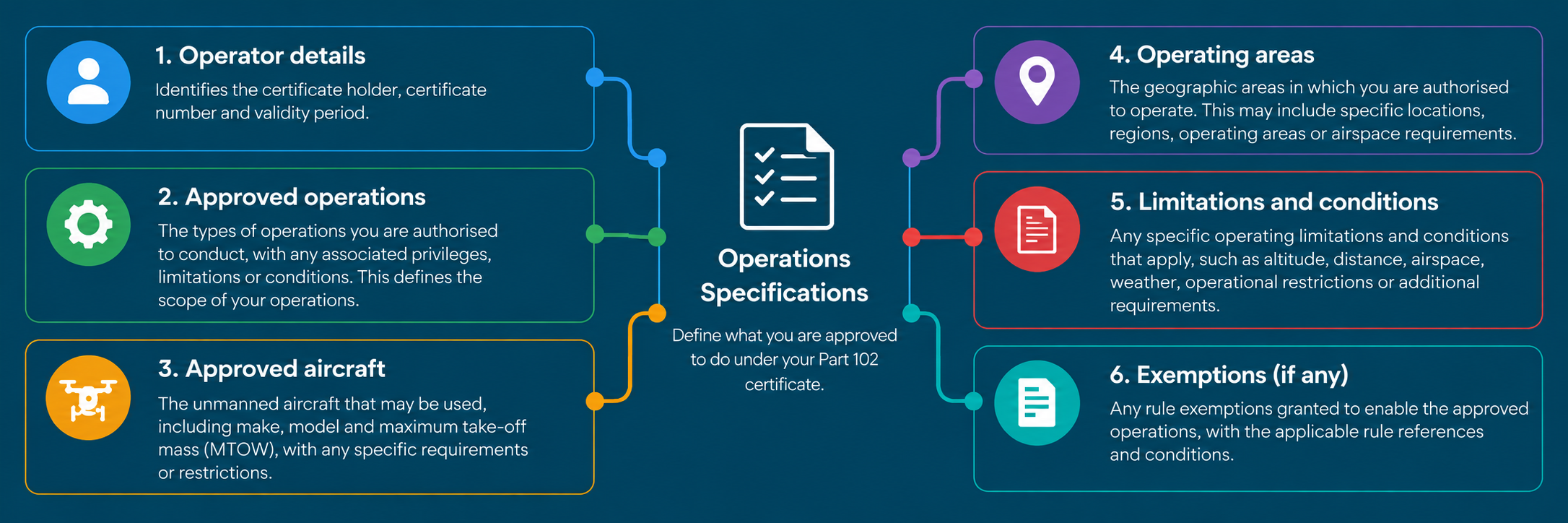
An unmanned aircraft operator certificate is accompanied by Operations Specifications, commonly referred to as Ops Specs.
These identify the scope of the operator's approval and provide an important reference for understanding what activities the operator is authorised to conduct.
Under Part 102, Operations Specifications include information such as:
The operator's identity and approved business names.
The aircraft authorised for use.
The types of operations and privileges approved.
The geographical areas in which operations are authorised.
Any applicable exemptions.
Additional conditions imposed by the CAA.
Understanding an operator's authorisation
Two operators holding Part 102 certificates may have substantially different operating privileges.
For example, one operator may be authorised to conduct specified night operations, while another may hold approvals for particular BVLOS activities or specialised aircraft.
Even where operators hold similar privileges, their operating limitations and procedures may differ.
Operations Specifications should therefore be considered alongside the operator's exposition and any other applicable conditions.
Can you ask to see an operator's Ops Specs?
Yes. If you are engaging a Part 102 operator, you can ask them to explain the scope of their authorisation and provide their Operations Specifications for review.
Many operators will be happy to share the relevant information, particularly when it helps customers, landowners or other stakeholders understand the proposed activity.
Relevant provisions: Rules 102.15, 102.17 and 102.21.
The operator's exposition
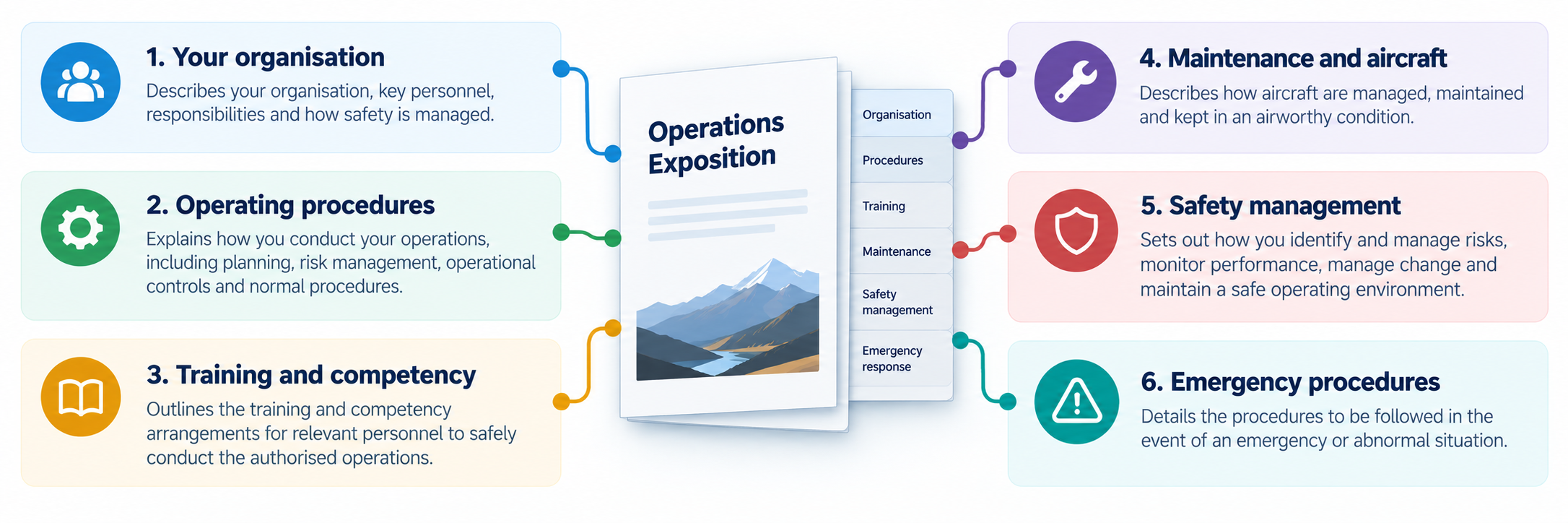
The exposition is a central component of Part 102 certification. It describes how the operator conducts its activities, manages aviation safety risks and maintains compliance with its approved operating arrangements.
The content and complexity of an exposition depend on the nature, scale and risk of the proposed operations.
What does an exposition contain?
Part 102 identifies a range of matters that may need to be addressed, including:
Organisation and responsibilities: The people responsible for the operation and the exercise of certificate privileges.
Risk management: Identification of hazards, assessment of risks and measures established to manage them.
Personnel and competency: Qualifications, training, competency and other requirements for pilots and support personnel.
Aircraft and equipment: The aircraft, control systems and equipment used in operations.
Maintenance and airworthiness: Procedures for maintaining aircraft and establishing their suitability for operation.
Operating procedures: How flights are planned and conducted, including relevant limitations and safety precautions.
Reporting: Procedures for reporting required information to the CAA.
Document control: How the exposition is maintained, amended and distributed.
A working operational document
An exposition is not simply a document prepared to obtain certification. It must remain an accurate description of the operator's activities and continue to be acceptable to the CAA.
Operators must maintain their expositions as their activities develop. Certain changes require prior CAA approval, while other amendments must be provided to the Authority in accordance with the applicable requirements.
Relevant provisions: Rules 102.11, 102.21 and 102.23.
Understanding what is actually required
Part 102 provides considerable flexibility in how operators establish and demonstrate appropriate safety arrangements. Although the Civil Aviation Rules prescribe certain requirements, many aspects of an operator's systems and procedures are developed to suit the nature, scale and risks of their particular activities.
Applicants may encounter advice about what a Part 102 operator must do. Such advice often reflects established industry practices, the experience of other operators or the preferred approach of an adviser, rather than an explicit regulatory requirement.
These practices may be entirely appropriate and beneficial, but they should not automatically be presented as mandatory.
There is an important distinction between requirements imposed by legislation or certification conditions, and procedures an operator elects to adopt in its exposition. Once incorporated into the operator's approved arrangements, those procedures become obligations that the operator is expected to follow.
Applicants should feel comfortable asking for the regulatory basis of any requirement presented as compulsory. Where no specific requirement exists, the focus should instead be on whether the proposed arrangement is appropriate, proportionate and capable of satisfying the CAA's assessment.
The objective is not to minimise an operator's safety obligations, but to ensure those obligations are understood, justified and suited to the operation.
Obtaining Part 102 certification
An individual or organisation seeking Part 102 certification must apply to the CAA and demonstrate that the proposed operations can be conducted safely.
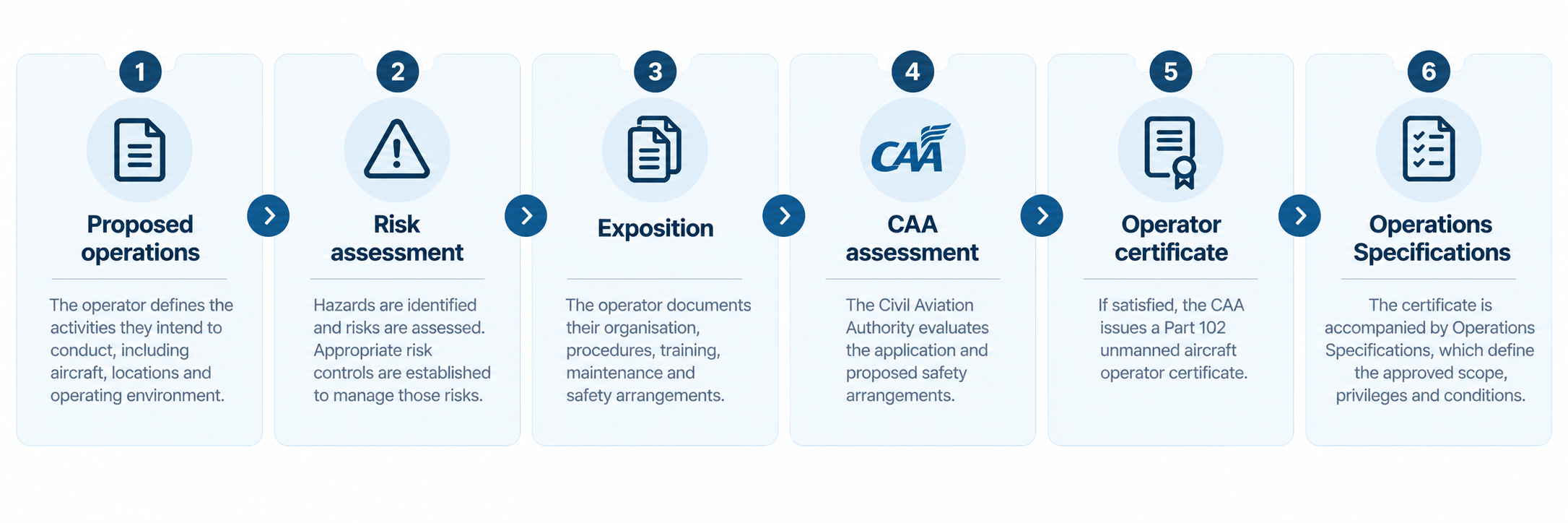
The process involves defining the intended activities, assessing their risks and developing appropriate operating arrangements.
Preparing an application
Applicants generally need to:
Define the proposed operations. Identify the activities, aircraft, locations and operating privileges being sought.
Assess the risks. Identify hazards associated with the proposed activities and determine how those risks will be managed.
Develop an exposition. Document the organisation's responsibilities, operating procedures, training, maintenance arrangements and other relevant controls.
Submit an application. Provide the required information, proposed Operations Specifications and exposition to the CAA.
Undergo CAA assessment. Demonstrate that the proposed systems and procedures are appropriate for the intended operations.
The CAA may request further information, clarification or changes during its assessment.
Grant of certification
If the CAA is satisfied that the applicable requirements have been met, it may grant an unmanned aircraft operator certificate accompanied by Operations Specifications.
The Authority may impose additional conditions where necessary for aviation safety.
Certification is not indefinite. Part 102 requires an expiry date, which cannot be more than five years after the certificate is granted. Operators wishing to continue beyond expiry must apply for renewal.
How long does certification take?
The time and effort involved depend on the nature of the proposed operations, the quality and completeness of the application, and the assessment required.
A straightforward application involving familiar operating activities may require considerably less development than one proposing novel aircraft, complex operations or extensive BVLOS privileges.
Applicants should allow sufficient time for developing their operating systems and for the CAA's assessment.
Relevant provisions: Rules 102.9, 102.13, 102.19 and 102.25.
Responsibilities after certification
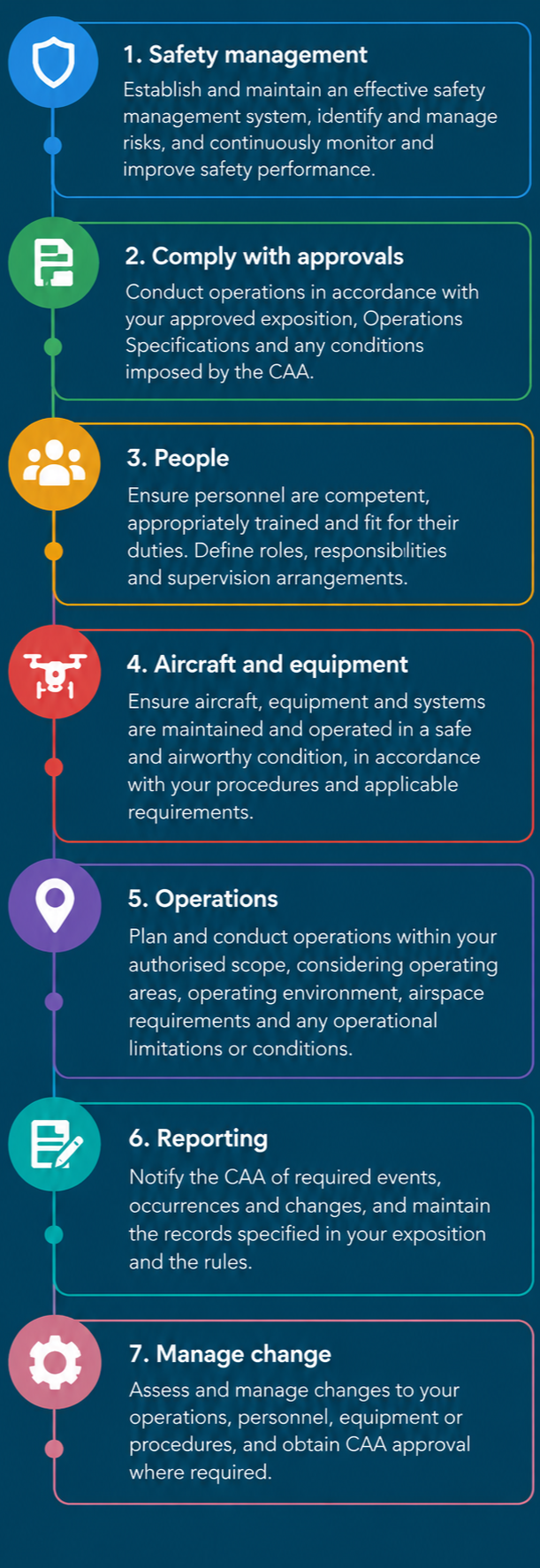
Part 102 certification brings ongoing responsibilities. Certificate holders must ensure that operations remain within their approved scope and that the systems established to manage aviation safety continue to be effective.
Operating within approved conditions
The certificate holder must comply with the applicable requirements of Part 101, the conditions of its Operations Specifications and its exposition.
The operator is also responsible for ensuring that pilots and other personnel involved in operations under the certificate are informed of, and comply with, those requirements.
Maintaining competency and equipment
The operator's approved arrangements may establish requirements for pilot competency, recurrent training, aircraft inspections, maintenance, operational records and other activities.
These requirements form part of the operator's ongoing safety system.
Managing changes
Changes to aircraft, personnel, operating activities or organisational arrangements may require amendments to the exposition or Operations Specifications.
Some changes require CAA approval before implementation. Operators must follow the applicable change-management requirements rather than assuming that an existing certificate covers every new activity.
Continuing CAA oversight
Certificated operators remain subject to regulatory oversight. This may include CAA assessments and other activities to establish whether the operator continues to comply with the applicable requirements.
Relevant provisions: Rules 102.11, 102.21 and 102.23.
Working with a Part 102 operator
Businesses, landowners, councils and other organisations may engage Part 102 operators for activities that require specialised aircraft, operating procedures or regulatory authorisations.
Part 102 certification provides a means of establishing that the operator has been assessed against a defined set of operating arrangements. However, the scope of certification varies between operators.
Understanding the proposed operation
When engaging an operator, it can be useful to establish:
Whether the operator holds a current Part 102 certificate.
Whether the proposed activity falls within its approved Operations Specifications.
Whether any particular operating conditions or limitations apply.
What permissions, site access arrangements or coordination may be needed.
Who is responsible for planning, conducting and supervising the operation.
Checking certification
The CAA publishes a list of Part 102 certificated operators. This can help establish whether an individual or organisation is listed as a certificate holder.
The published list does not, by itself, establish which activities the operator is authorised to conduct.
For details of a particular operation, the operator's Operations Specifications and applicable operating arrangements are the more relevant references.
Choosing an operator
The appropriate operator will depend on the proposed activity.
Experience with the type of operation, suitable aircraft, competent personnel and relevant operating privileges may be more important than certification status alone.
For activities that can be conducted entirely under Part 101, Part 102 certification is not necessarily required.
Check out our members list to see if there’s a suitably qualified operator near you.
Relevant provisions: Rules 102.3, 102.15, 102.17 and 102.21.
Regulatory resources
Civil Aviation Rule Part 102
The requirements for unmanned aircraft operator certification, including expositions, Operations Specifications and certificate holder responsibilities.
Advisory Circular AC102-1
CAA guidance on acceptable means of compliance, risk assessment and developing an exposition.
Application forms and sample exposition
CAA application and amendment forms, together with an example exposition for applicants developing their documentation.
CAA certificated operators list
A public list of Part 102 certificate holders in New Zealand.
About this guide
This page provides general information about unmanned aircraft operator certification in New Zealand. It is intended to assist understanding of the regulatory framework and does not replace the Civil Aviation Rules, applicable transport instruments, individual operating authorisations or advice from the Civil Aviation Authority.
The privileges and conditions of a particular Part 102 operator must be established from that operator's certification documentation.