
Part 101 - General Operating Rules
Understanding the requirements for operating drones in New Zealand
Part 101 establishes the general operating rules for unmanned aircraft in New Zealand. It provides a framework under which many recreational and commercial drone operations can be conducted without requiring Part 102 certification.
Operators must comply with the applicable requirements, including those relating to visual line of sight, operating height, people and property, aerodromes and airspace.
This guide explains the principal requirements for remotely piloted aircraft, including relevant exceptions and circumstances where additional authorisation may be necessary.
Visual line of sight
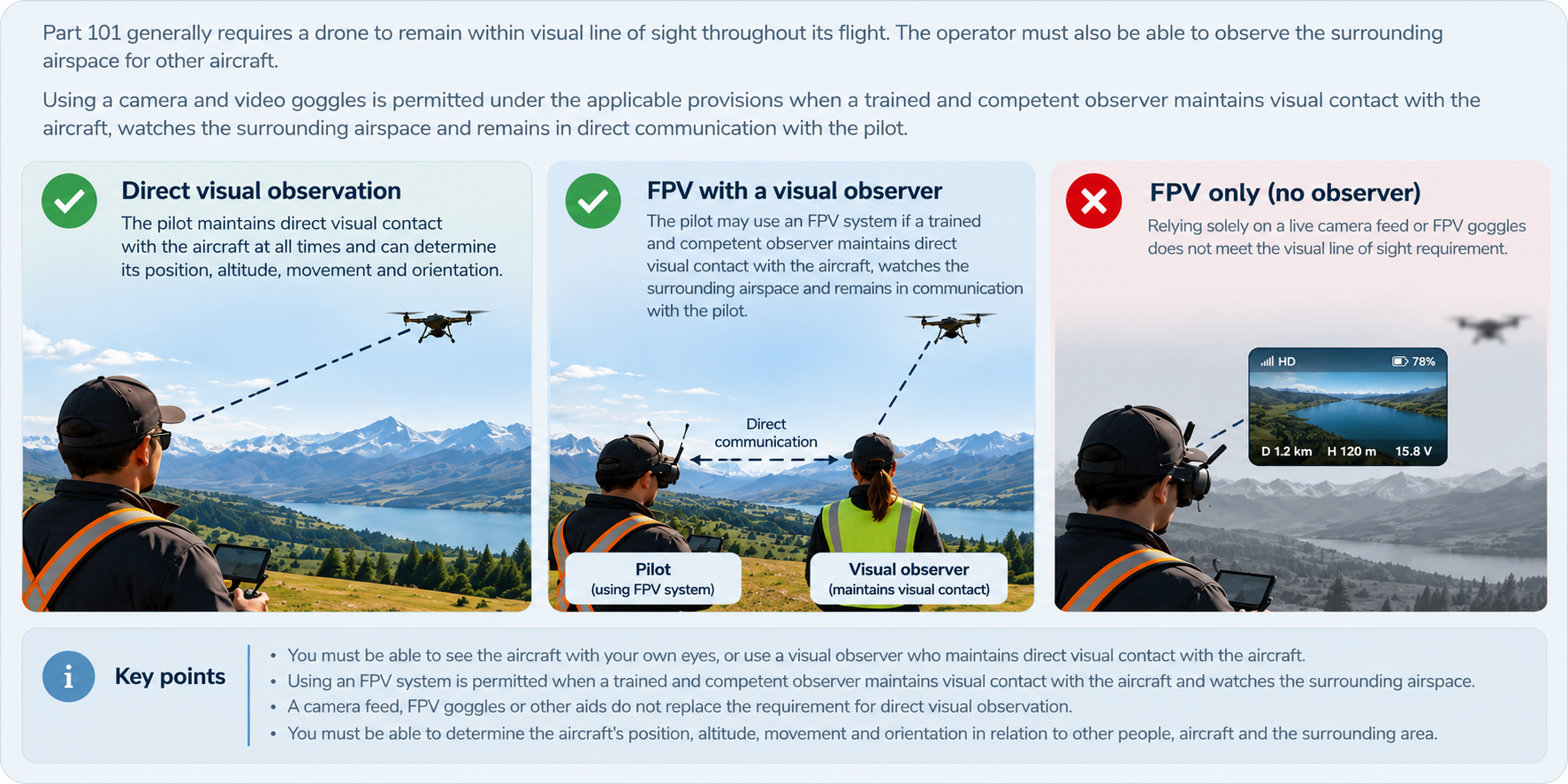
Part 101 generally requires a drone to remain within visual line of sight throughout its flight. The operator must also be able to observe the surrounding airspace for other aircraft.
Visual line of sight means being able to see the aircraft directly, rather than relying solely on its camera, telemetry or position displayed on a screen. Normal corrective glasses or contact lenses may be used.
Using first-person view (FPV)
Flying using a camera and video goggles is permitted under the applicable provisions when a trained and competent observer maintains visual contact with the aircraft, watches the surrounding airspace and remains in direct communication with the pilot.
Exceptions
Part 101 also provides a limited exception for operations within an enclosed area from which the aircraft cannot physically escape, provided entry by people is controlled to ensure their safety.
Other beyond-visual-line-of-sight operations generally require an appropriate Part 102 authorisation.
Relevant provisions: Rule 101.209 and CATI 101-1, clause 2.9.
Operating height
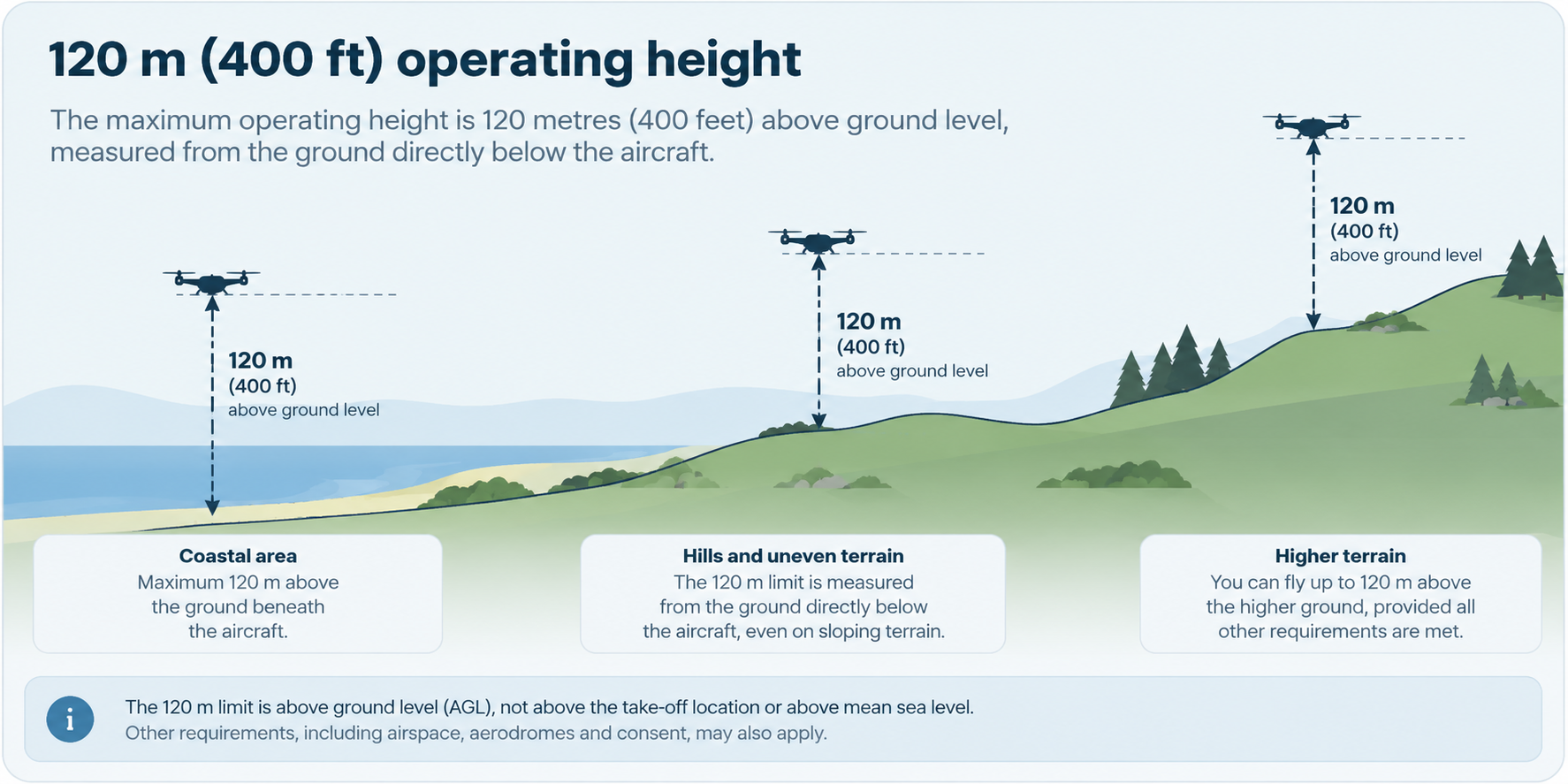
For most Part 101 operations, the maximum operating height is 400 feet (approximately 120 metres) above ground level.
This is measured relative to the ground beneath the aircraft, not from the elevation of the take-off location or from sea level.
Operating above 400 feet
Part 101 provides specific pathways for operations above the general height limit.
These include operations within a danger area designated for that purpose, or certain operations that:
Remain in Class G airspace.
Are more than 4 km from the nearest aerodrome boundary.
Are notified for the issue of a NOTAM at least 24 hours in advance by a person appropriately authorised through an approved person or organisation.
The requirements for operating near aerodromes and within controlled airspace must also be considered.
Relevant provisions: Rule 101.207 and CATI 101-1, clause 2.5.
People and property
Part 101 establishes consent requirements for flying in airspace above people and property.
Flying over people
As a general rule, a drone must not be operated in airspace above a person who has not consented to the aircraft operating there.
Consent can be obtained before the operation and should be appropriate to the circumstances. Operators should ensure people understand what they are consenting to.
Flying over property
Prior consent must generally be obtained from the property owner or a person occupying the property before operating a drone above it.
The rules do not specify that consent must always be in writing. However, written permission can be useful, particularly for commercial operations or where the boundaries and conditions of the consent need to be established.
Public land, councils and DOC
Publicly accessible land is not automatically available for unrestricted drone operations.
Depending on the location, permission may be required from a council, the Department of Conservation, another public authority or the relevant property occupier.
Different land managers have different policies and permission processes. Operators should establish who manages the land and what permissions apply before flying.
Consent to overfly versus permission to take off
Consent to operate in airspace above property is not necessarily the same as permission to launch, land or conduct activities on that land.
Separate land-use rules, bylaws, reserve conditions or other restrictions may apply, even where the aviation consent requirements have been satisfied.
Exceptions
The consent provisions contain limited exceptions, including certain operations under approved organisations in established operating areas. A Part 102 operator may also hold specifically approved alternative arrangements.
Relevant provisions: Rule 101.207 and CATI 101-1, clause 2.5.
Operating near aerodromes
Part 101 imposes additional requirements on drone operations conducted on or within 4 km of the boundary of a relevant aerodrome.
This is not limited to large commercial airports. Smaller aerodromes may also be subject to these requirements, which can include hospital landing pads and places aircraft regularly operate.
The 4 km boundary
The distance is measured from the aerodrome boundary, not from the runway centre or airport terminal.
Operations within this area generally require the pilot to hold an appropriate qualification or licence, or to operate under the specified supervision arrangements.
Additional requirements depend on whether the aerodrome is controlled or uncontrolled.
Controlled aerodromes
Operations within the relevant boundary of a controlled aerodrome require authorisation from the appropriate air traffic control unit, subject to the applicable exceptions.
Uncontrolled aerodromes
Operations generally require an agreement with the aerodrome operator. For remotely piloted aircraft, the applicable requirements also include an observer to provide additional awareness of approaching aircraft and restrictions on operating height.
Shielded operations
A limited exception exists for qualifying shielded operations outside the aerodrome boundary, where the aircraft is protected from the aerodrome by a physical barrier capable of arresting its flight.
The specific conditions of this exception must be satisfied; simply flying close to a building or below a tree does not necessarily qualify.
Identifying an aerodrome
Part 101 uses a specific definition of aerodrome, linked to aerodromes promulgated in the current Aeronautical Information Publication New Zealand (AIPNZ).
Operators should not assume that only major airports are relevant, or that every informal landing site automatically falls within this particular definition.
Relevant provisions: Rule 101.205 and CATI 101-1, clause 2.3.
Schematic only. Not to scale. Actual aerodrome boundaries and applicable requirements must be established from current information.
Operating within 4 km
Additional requirements apply when operating on or within 4 km of a relevant aerodrome boundary. These depend on the aerodrome, pilot qualifications and operating arrangements.
The distance is measured from the aerodrome boundary, not the runway centre.
Night operations
Part 101 permits certain drone operations at night, but additional requirements apply.
Indoor and shielded operations
Night operations may be conducted indoors or as qualifying shielded operations, subject to the other applicable rules.
Other night operations
CATI 101-1 also provides a pathway for night operations where the pilot has completed appropriate authorised training.
Additional requirements include:
A qualifying night-training course.
A 30-minute shielded night operation to regain familiarity if the pilot has not flown at night during the preceding 90 days.
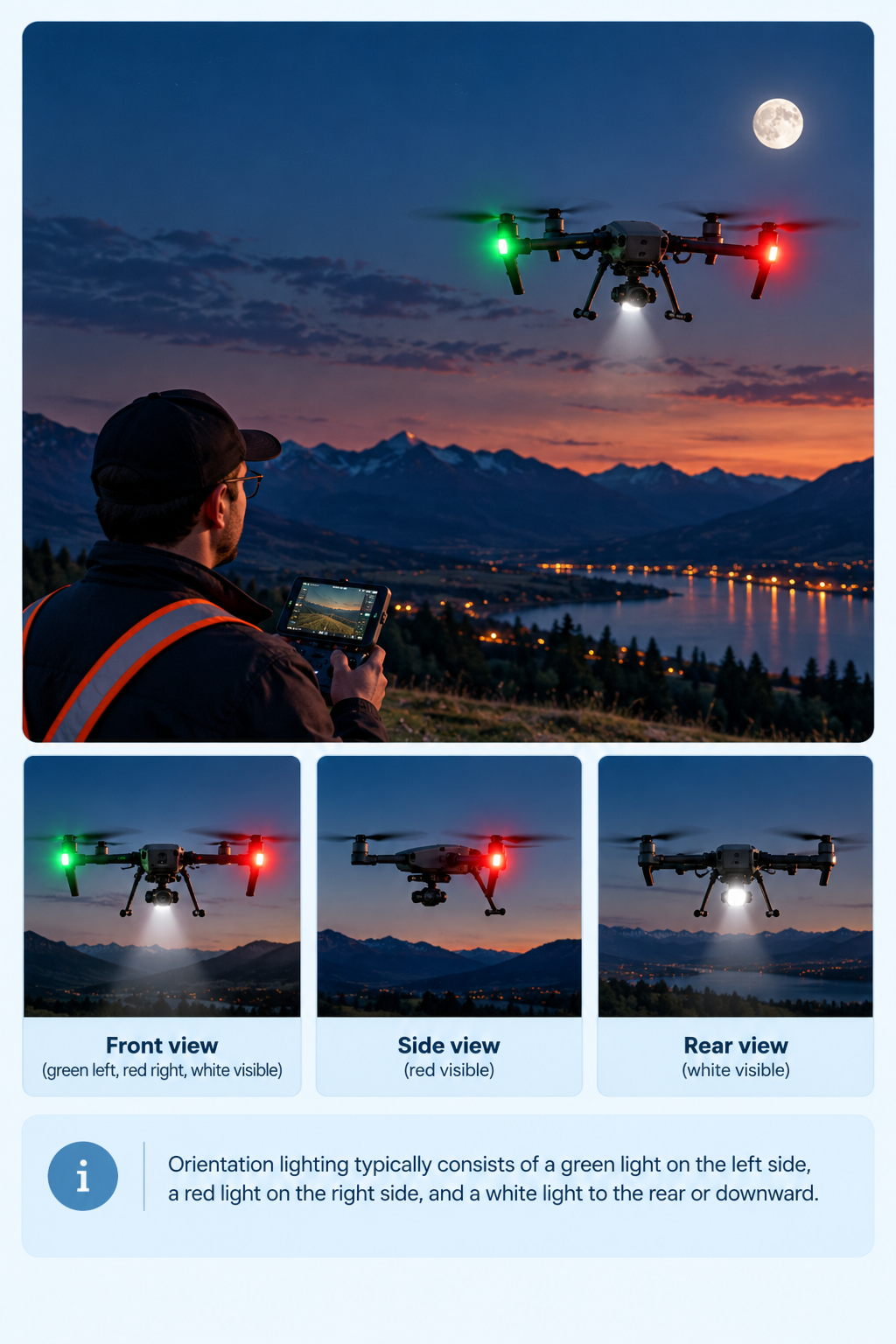
Appropriate aircraft lighting that allows its orientation to be determined throughout the flight.
Operating no more than one aircraft at a time.
The normal requirements relating to visual line of sight, airspace, aerodromes and other safety obligations remain relevant.
Relevant provisions: Rule 101.211 and CATI 101-1, clause 2.11.
Aircraft mass
The gross mass of a drone determines whether additional requirements apply under Part 101.
Aircraft up to 15 kg
Most remotely piloted aircraft below 15 kg can operate under Part 101 without a special aircraft approval, provided all other applicable requirements are met.
Aircraft between 15 kg and 25 kg
Additional requirements apply to remotely piloted aircraft in this mass range.
The aircraft and any modifications must be constructed under the authority of, or inspected and approved by, an appropriately approved person or organisation.
The aircraft must also be operated under the authority of an approved person or organisation.
Aircraft above 25 kg
Remotely piloted aircraft exceeding 25 kg cannot be operated under the ordinary Part 101 mass provisions. Operations involving larger aircraft require an appropriate alternative regulatory pathway, generally involving Part 102 certification.
Relevant provisions: Rule 101.215 and CATI 101-1, clause 2.15.
Safety obligations
Part 101 places general safety responsibilities on drone operators, in addition to its more specific operating requirements.
Hazards and risks
Operators must take appropriate steps to minimise hazards to people, property and other aircraft.
This includes considering the operating environment, aircraft condition, weather, potential failures and the consequences of losing control of the aircraft.
Right of way
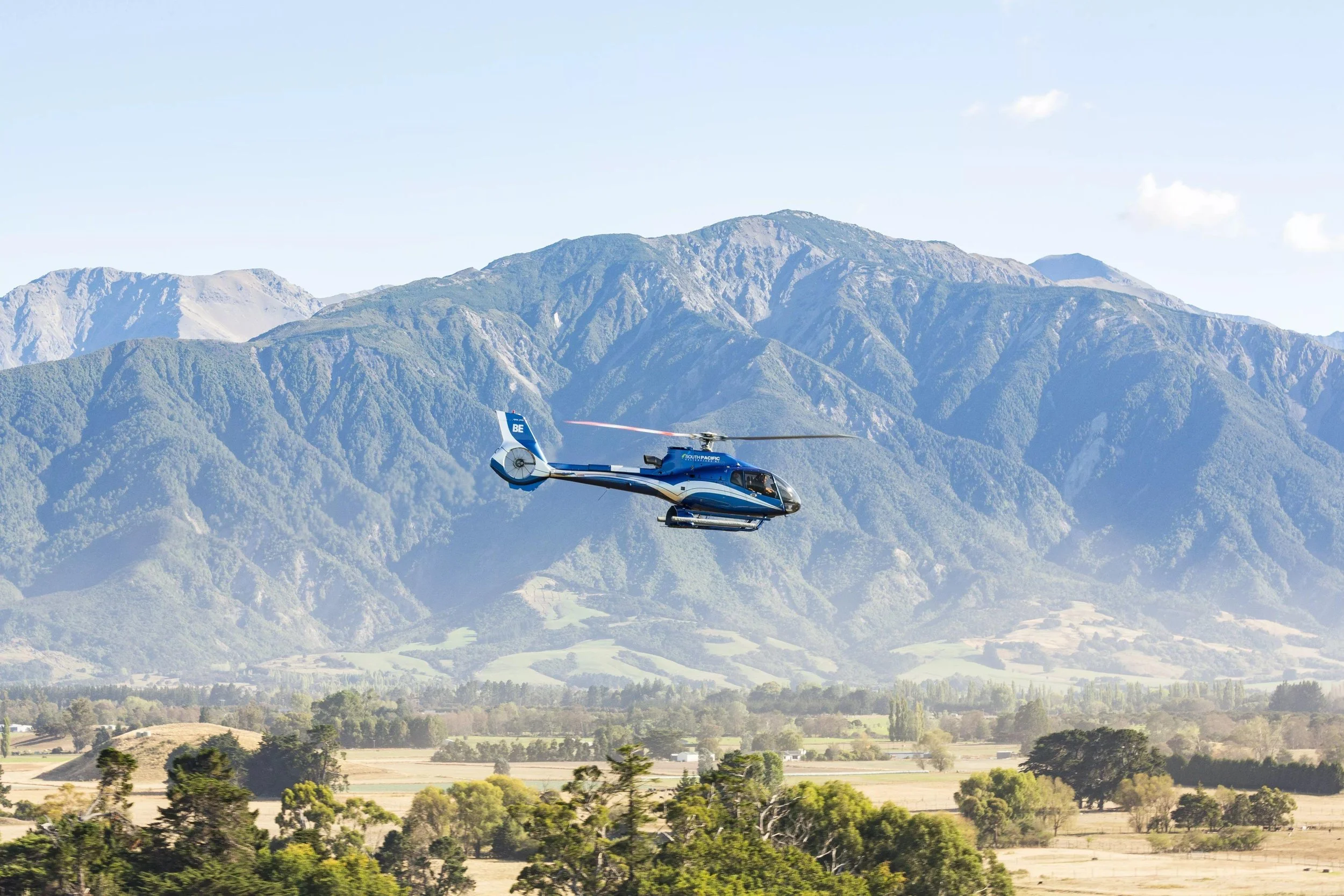
Remotely piloted aircraft must give way to and remain clear of crewed aircraft, both on the ground and in flight.
Drone pilots must maintain awareness of surrounding aviation activity and be prepared to take appropriate action to avoid conflicts.
Aircraft condition
Before operating, pilots should establish that the aircraft is suitable for the intended flight and can be operated safely.
Relevant considerations include propulsion, batteries, flight controls, communications, navigation systems and any payload carried.
Dropping articles
Part 101 also contains requirements concerning dropping objects from aircraft. Operations involving the release or application of material must be assessed against the applicable aviation requirements and any other relevant legislation.
Relevant provisions: Rules 101.13, 101.15 and 101.213; CATI 101-1, clause 2.13.
Airspace requirements
The airspace in which a drone operates can impose requirements in addition to the general Part 101 operating conditions.
Controlled airspace
Operations in controlled airspace generally require appropriate air traffic control authorisation, unless a specific exception applies.
Qualifying shielded operations may be permitted under the applicable provisions and limitations.
Restricted and military operating areas
Certain designated airspace areas are subject to additional restrictions, approvals or operating conditions.
Operators must establish the status of the airspace and obtain any required permission before entering it.
Low flying zones
Low flying zones are established for aviation activities conducted at low altitude. Drone operations in these areas require particular attention to the applicable rules and the potential presence of crewed aircraft.
Checking airspace
Operators should consult current aeronautical information and relevant flight-planning resources before flying.
Tools such as AirShare and HAAST can assist with situational awareness, but they do not replace the legal requirements or necessary authorisations.
For a more detailed explanation of airspace classifications, charts, NOTAMs and flight planning, see our dedicated Understanding New Zealand Airspace page.
Relevant provisions: Rules 101.7, 101.9, 101.11 and 101.12; CATI 101-1, clause 2.7.